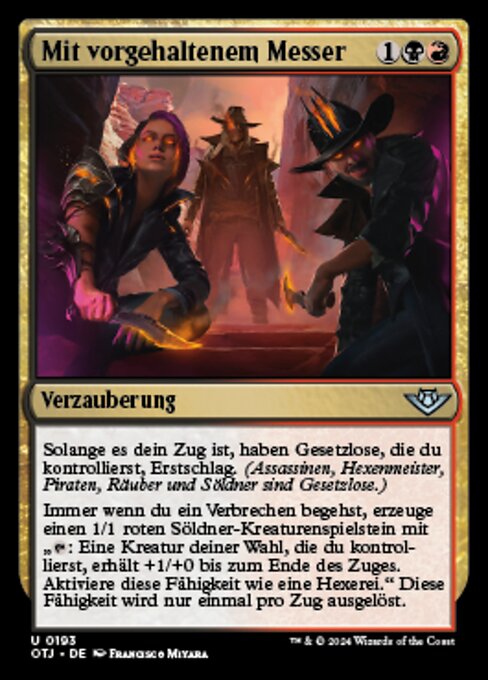
Mit vorgehaltenem Messer 


At Knifepoint
Verzauberung
Stampata (DE)
Verzauberung
Solange es dein Zug ist, haben Gesetzlose, die du kontrollierst, Erstschlag. (Assassinen, Hexenmeister, Piraten, Räuber und Söldner sind Gesetzlose.)
Immer wenn du ein Verbrechen begehst, erzeuge einen 1/1 roten Söldner-Kreaturenspielstein mit „ : Eine Kreatur deiner Wahl, die du kontrollierst, erhält +1/+0 bis zum Ende des Zuges. Aktiviere diese Fähigkeit wie eine Hexerei." Diese Fähigkeit wird nur einmal pro Zug ausgelöst.
Testo oracle (EN)
Enchantment
During your turn, outlaws you control have first strike. (Assassins, Mercenaries, Pirates, Rogues, and Warlocks are outlaws.)
Whenever you commit a crime, create a 1/1 red Mercenary creature token with ": Target creature you control gets +1/+0 until end of turn. Activate only as a sorcery." This ability triggers only once each turn.
Dettagli della stampa
- Set
- OTJ · 193
- Rarità
- Non comune
- Lingua
- DE
- Artista
- Francisco Miyara
- Uscita
- 2024-04-19
- Prezzi
- – · –
Andamento del prezzo
La tendenza compare con almeno 7 giorni di storico.
- Cardmarket, trend
- CardTrader, minimo Near Mint (DE)
Lo storico parte dal 28 ottobre 2026 e si allunga ogni giorno.
Mostra i dati
| Data | Cardmarket, trend | CardTrader, minimo Near Mint (DE) |
|---|---|---|
| 1 novembre 2026 | 0,13 € | 0,34 € |
| 29 ottobre 2026 | 0,15 € | 0,34 € |
| 28 ottobre 2026 | 0,14 € | 0,34 € |
Prezzi
| Fonte | Normale | Foil |
|---|---|---|
| Cardmarket | minimo – trend 0,13 € media 30 gg 0,14 € | minimo – trend 0,26 € media 30 gg 0,22 € |
| CardTrader (DE) | NM da 0,34 € con Zero da 0,34 € | NM da – |
| CardTrader (tutte le lingue) | NM da 0,11 € | NM da 0,11 € |
Cardmarket aggiornato il 2 nov 2026 · CardTrader aggiornato il 2 nov 2026
Compra e consulta
Legalità
- standard Legale
- pioneer Legale
- modern Legale
- legacy Legale
- vintage Legale
- commander Legale
- pauper Non legale
- alchemy Non legale
- brawl Legale
- competitivebrawl Legale
- duel Legale
- future Legale
- gladiator Legale
- historic Legale
- oathbreaker Legale
- oldschool Non legale
- paupercommander Non legale
- penny Non legale
- predh Non legale
- premodern Non legale
- standardbrawl Legale
- timeless Legale
- tlr Legale
Ruling
-
Changing the target or targets of a spell or ability won’t affect whether or not the controller of that spell or ability has committed a crime. Only the initial targets chosen for that spell or ability are used to determine whether or not its controller committed a crime.
-
A player commits a crime as they cast a spell, activate an ability, or put a triggered ability on the stack that targets at least one opponent, at least one permanent, spell, or ability an opponent controls, and/or at least one card in an opponent’s graveyard.
-
If an ability refers to an outlaw or whether a player controls an outlaw, it’s referring only to permanents with one or more of the creature types specified above. Notably, it’s not referring to any spell or card not on the battlefield. However, other abilities may refer to an “outlaw spell” or “outlaw card” in a zone other than the battlefield. Those abilities refer to spells and cards with one or more of the specified creature types.
-
Outlaw is not a creature type. If an effect asks you to choose a creature type, you can’t choose outlaw.
-
A player can commit only one crime per spell or ability they control. Targeting multiple opponents, permanents, spells, abilities, and/or cards with the same spell or ability doesn’t constitute committing multiple crimes.
-
A card, spell, or permanent is an outlaw if it has the Assassin, Mercenary, Pirate, Rogue, or Warlock creature type. It doesn’t matter if it has more than one of those creature types; as long as it has at least one, it’s an outlaw.
-
Creatures that deal first strike combat damage but lose first strike before regular combat damage is dealt won’t deal combat damage again unless they have double strike. This means you can’t have At Knifepoint leave the battlefield to have your outlaws deal combat damage twice in a turn.
-
The spell or ability that constituted a crime doesn’t have to have resolved yet or at all. As soon as you’re finished casting the spell, activating the ability, or putting the triggered ability on the stack, you’ve committed a crime.
-
For example, an ability that triggers when you cast a spell that targets an opponent will trigger at the same time as an ability that triggers whenever you commit a crime. Those abilities can be put on the stack in either order (if you control them both), and they’ll both resolve before the spell that caused them to trigger.