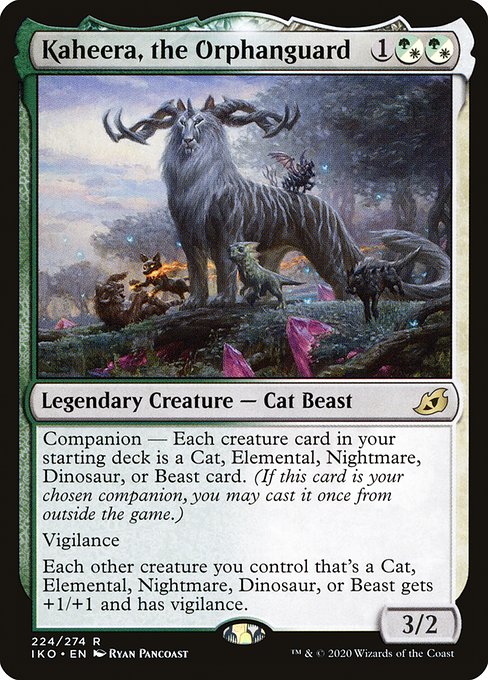
Kaheera, the Orphanguard 

Legendary Creature — Cat Beast3/2
Testo oracle (EN)
Legendary Creature — Cat Beast
Companion — Each creature card in your starting deck is a Cat, Elemental, Nightmare, Dinosaur, or Beast card. (If this card is your chosen companion, you may put it into your hand from outside the game for  as a sorcery.)
Vigilance
Each other creature you control that's a Cat, Elemental, Nightmare, Dinosaur, or Beast gets +1/+1 and has vigilance.
Dettagli della stampa
- Set
- IKO · 224
- Rarità
- Rara
- Lingua
- EN
- Artista
- Ryan Pancoast
- Uscita
- 2020-04-24
- Prezzi
- 0,75 € · 0,86 USD
Andamento del prezzo
La tendenza compare con almeno 7 giorni di storico.
- Cardmarket, trend
- CardTrader, minimo Near Mint (EN)
Lo storico parte dal 28 ottobre 2026 e si allunga ogni giorno.
Mostra i dati
| Data | Cardmarket, trend | CardTrader, minimo Near Mint (EN) |
|---|---|---|
| 31 ottobre 2026 | 0,74 € | 0,33 € |
| 30 ottobre 2026 | 0,75 € | 0,33 € |
| 29 ottobre 2026 | 0,76 € | 0,33 € |
| 28 ottobre 2026 | 0,80 € | 0,33 € |
Prezzi
| Fonte | Normale | Foil |
|---|---|---|
| Cardmarket | minimo – trend 0,74 € media 30 gg 0,66 € | minimo 0,50 € trend 1,26 € media 30 gg 1,22 € |
| CardTrader (EN) | NM da 0,33 € con Zero da 0,85 € | NM da 1,03 € con Zero da 1,03 € |
| CardTrader (tutte le lingue) | NM da 0,33 € | NM da 1,03 € |
Cardmarket aggiornato il 31 ott 2026 · CardTrader aggiornato il 31 ott 2026
Compra e consulta
Legalità
- standard Non legale
- pioneer Legale
- modern Legale
- legacy Legale
- vintage Legale
- commander Legale
- pauper Non legale
- alchemy Non legale
- brawl Legale
- competitivebrawl Legale
- duel Legale
- future Non legale
- gladiator Legale
- historic Legale
- oathbreaker Legale
- oldschool Non legale
- paupercommander Non legale
- penny Legale
- predh Non legale
- premodern Non legale
- standardbrawl Non legale
- timeless Legale
- tlr Legale
Ruling
-
Before shuffling your deck to become your library, you may reveal one card from outside the game to be your companion if your starting deck meets the requirements of the companion ability. You can't reveal more than one. It remains revealed outside the game as the game begins.
-
You may have one companion in the Commander variant. Your deck, including your commander, must meet its companion requirement. Your companion is not one of your one hundred cards.
-
The requirements of the companion ability apply only to your starting deck. They do not apply to your sideboard.
-
If more than one player wishes to reveal a companion, the starting player does so first, and players proceed in turn order. Once a player has chosen not to reveal a companion, that player can't change their mind.
-
The companion's other abilities apply only if the creature is on the battlefield. They have no effect while the companion is outside the game.
-
Paying
to put your companion into your hand is a special action. It doesn't use the stack and players can't respond to it. Once you take this action, you may cast that card if it's legal to do so before any other player can take actions. -
A creature that's more than one of the five types gets +1/+1 only once from Kaheera's last ability.
-
The companion ability has no effect if the card is in your starting deck and creates no restriction on putting a card with a companion ability into your starting deck. For example, Zirda may be in your starting deck even if your other permanent cards don't all have activated abilities.
-
If you reveal a companion outside the game, for as long as it remains there, you may pay
any time you could cast a sorcery (that is, you have priority during your main phase and the stack is empty). Once you do, you put it into your hand and behaves like any other card you've brought into the game. For example, if it's discard, countered, or destroyed, it's put into your graveyard, remaining in the game. This is a change from previous rules. -
Creature cards in your deck may be a mix of the five creature types that Kaheera cares about. They may also have additional types, as long as each creature card is at least one of those five. Noncreature cards may have any subtypes.
-
Your companion begins the game outside the game. In tournament play, this means your sideboard. In casual play, it's simply a card you own that's not in your starting deck.
-
Once you put your companion into your hand, it behaves like any other card you’ve brought into the game. For example, if it’s countered or destroyed, it’s put into your graveyard, remaining in the game.
-
Paying
to put your companion into your hand is a special action. It doesn't use the stack and players can't respond to it. Once you take this action, you may cast that card if it's legal to do so before any other player can take actions. -
If you reveal a companion outside the game, for as long as it remains there, you may pay
any time you could cast a sorcery (that is, you have priority during your main phase and the stack is empty). Once you do, you put it into your hand and behaves like any other card you've brought into the game. For example, if it's discarded, countered, or destroyed, it's put into your graveyard, remaining in the game. This is a change from previous rules. -
Wizards of the Coast has issued functional errata for the Companion mechanic. Instead of casting companions from outside the game: Once per game, any time you could cast a sorcery (during your main phase when the stack is empty), you can pay
to put your companion from your sideboard into your hand. This is a special action, not an activated ability. It happens immediately and can’t be responded to. It can’t be countered or stopped by cards like Phyrexian Revoker. For more information please see https://magic.wizards.com/en/articles/archive/news/june-1-2020-banned-and-restricted-announcement